
A Thousand Words


It’s not really about the survey, but could you fill it out please?
I generally don’t talk about models that create images or video here; that’s not an area of expertise for me, and there are completely different workflows, ethical concerns and use cases that I’m unaware of. But I do use LLMS — ChatGPT in particular — to create the lovely illustrations that accompany posts here, including today’s. (At least, I like them.)
But the reason I’m writing about today’s illustration has nothing to do with my impeccable taste in art; it’s really about — yet another — example of how fast AI is moving, and how its capabilities are both broadening and deepening. And how we need to reframe our thinking about AI in response.
Also, please take the survey.
So my process is, I’ll write a post, usually in discussion with Claude and Adiel, my partner in crime, and then turn to ChatGPT for ideas on an image to illustrate it. It’s — bluntly — often far too literal and pedantic to generate anything useful, but sometimes it will spark an idea that I can refine and use as a prompt. A couple of rounds, usually, and I have something I like.
This time was slightly different. We had written about our chatbot-driven survey in March (thanks to everyone who filled it out), and as threatened promised, were planning to send out the next round of queries now. (To digress, it’s a survey that’s really a conversation with an AI system about how you think about AI and news; we come back to you regularly to see what may have changed. Have you taken the survey? Please take the survey.)
We were going to spam email our subscribers, but I wanted to send a personal note to some of you. (And if you didn’t get one from me, I love you anyway.) But I wanted it to have some humor. And I remembered the famous National Lampoon cover with the “If You Don’t Buy This Magazine, We’ll Kill This Dog” from 1973.
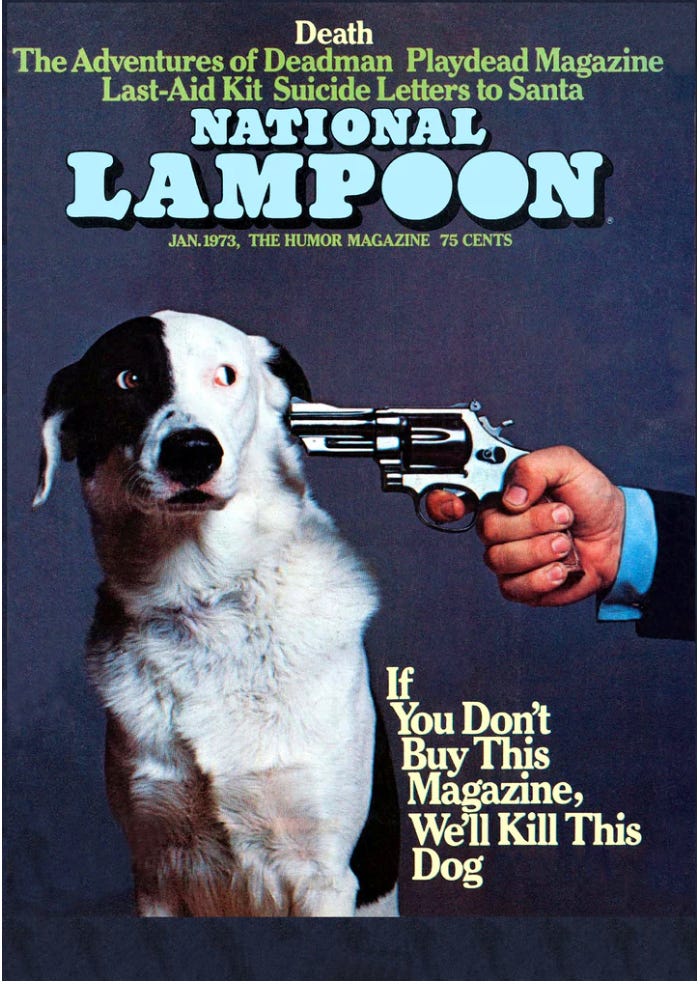
Wouldn’t it be funny, I thought, if we could make a similar image, except for the survey. (Yes, I’m seeing a therapist.) So I asked ChatGPT if it knew the cover (it did) and whether it could make a similar one that exhorted people to take the survey. It demurred.
It’s not allowed to make an image of a dog being threatened, it said. But, it added helpfully, it could generate all kinds of acceptable (to it) alternatives, including one where the dog gets a reminder email if you don’t take the survey. (Presumably a fate better than being shot, but the jury is out on that.)
We chatted a bit more. I agreed to let it come up with a cover about the dog getting threatened with an email, asked that the magazine be called CUNY, and set it off. That was it. End of prompt.
What you see above is what I got back.
It’s not that it’s a great, funny, smart image. It’s that every part of it works. The taglines on CUNY: THE CITY. THE CAMPUS. THE CHAOS. The pile of unanswered letters. The callouts to imaginary stories on the left. The sticker on the laptop.
And yes, we all know that AI systems can generate realistic images of all kinds with a little help. And, to be sure, the core idea is mine. But I’m struck by a few thoughts here: ChatGPT, which I hadn’t thought of as being particularly subtle in language, understood humor in a pretty sophisticated way. Its choice of words are on point. The overall synthesis of the idea was clean, and complete. It needed a real sense of the context — of CUNY, of surveys, of survey reminders — to pull this together.
Perhaps I’m overindexing on a single image, built with more or less a single prompt and with very little direct context fed into it. But the point is that, a year ago, I was having trouble getting AI systems to turn out images that even faintly resembled what I pictured in my mind. Six months ago, the image-generation capabilities were much better, but I still had to direct the system. And now, this.
It still won’t come up with great ideas on its own, but how far off is that day?
Which is to say: I note here, often, that LLMs are outstanding at editing, both in terms of proofreading and broader structural analysis of a piece. Their writing is at best leaden.
And that’s because — I think — it’s focusing on what it’s trying to say rather than who it’s communicating to. (I realize there’s a ton of assumed anthropomorphizing in there, but bear with me.) That’s certainly my experience when it suggests an edit to a line I’m writing; it will diagnose a problem perfectly, and then write the most pedantic version possible as a suggestion. The image shows what it can do when there’s a template it can follow — in this case, the original National Lampoon cover — and it can extrapolate from that what message it’s trying to communicate. So perhaps it can’t write War And Peace from scratch, but what can it do with a format that’s more or less templated?
And a lot of our work is templated. How long before its writing becomes as sophisticated as some of the best work we can do?
I write this not to scare us, particularly, but to make the case that we can’t assume AI’s limitations today will be its limitations tomorrow. Given the speed that it’s progressing, I hate to be dogmatic about areas of endeavor it will never be able to hit parity — or more — with humans on.
So what does that mean for newsroom strategy? Good question. We can’t plan for a future where capabilities improve every week, but we can at least not build strategies that assume that AI models are stuck at their current level of development forever.
They’re getting better, and they’re getting better, faster.
How are you thinking about AI and your newsroom?
You could take the survey and tell us.