

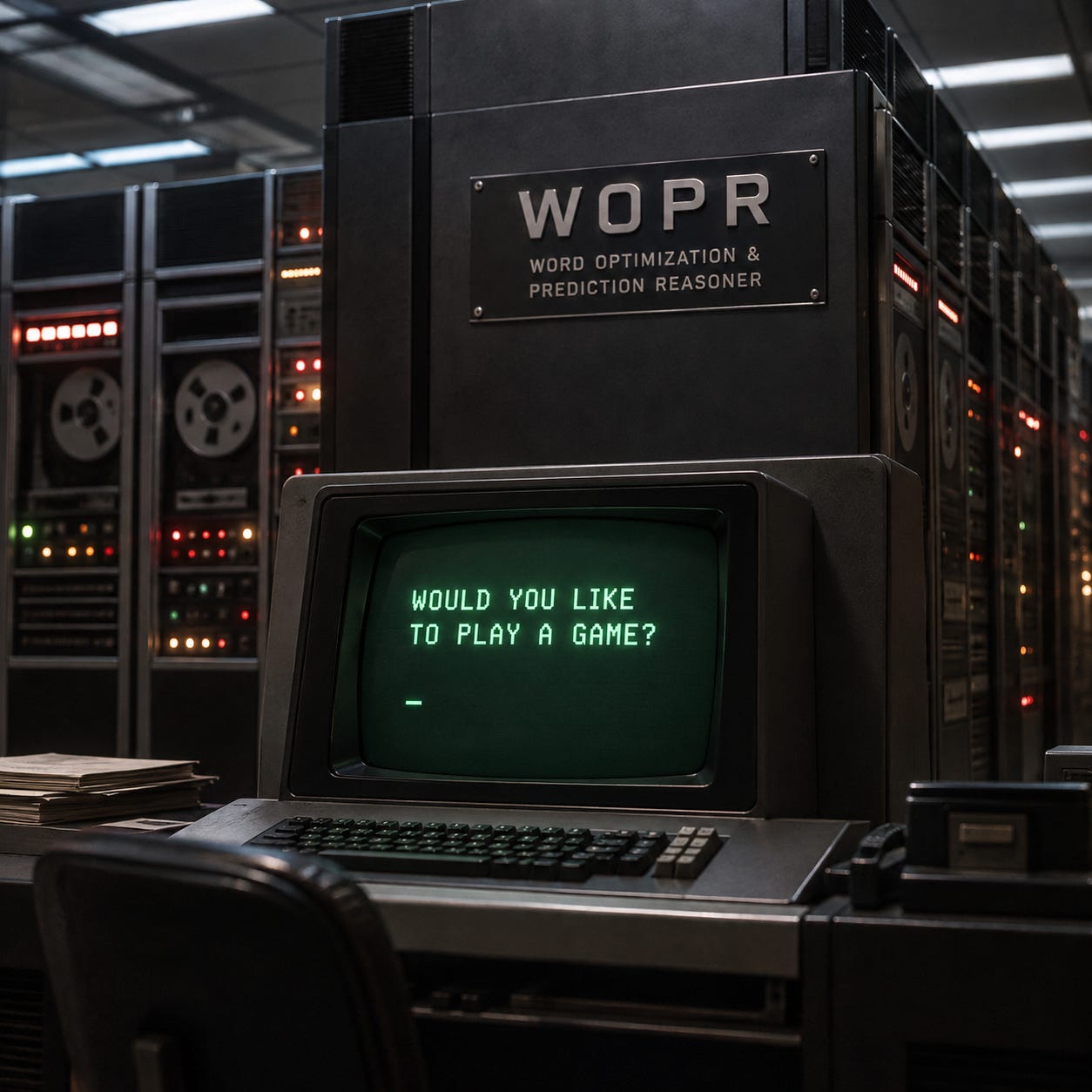
Are we all going to die, or what?
(Bonus points for remembering the movie the image references.)
The Wall Street Journal had perhaps the best headline to summarize the current zeitgeist about the possible/likely/inevitable robot apocalypse: America’s Great AI Freakout Has Begun. There’s a pithy — but also non-judgmental — quality to it: we’re panicking, but it’s not clear if that is or isn’t justified.
Lots of people have views. If you haven’t been living under a rock for the last three weeks, you’ve read some of them. The views that ought to matter are from the people who know something about the technology and have worked with it — which, to be clear, does not include me. Some are very worried, and that seems to include the CEO of Anthropic. Some are more sanguine, like my colleague at Semafor, Reed Albergotti. Other suggest there are elements of marketing here, as they did when Anthropic announced the release of — and then restricted — its Mythos model. I lean on the freakout side myself, but then again, what do I know?
(Not the Skynet/Cylon kind of apocalypse, but closer to HAL9000; the idea that systems we don’t have full control over have more and more control over the systems we depend on — traffic grids or hospital records, for example. While the panic over the OpenAI-Hugging Face incident has focused on the agents’ hack of Hugging Face, what’s far more interesting — concerning — is the behavior the bots exhibited well before that event: how they self-organized, created strategies, planned and coordinated actions. In other words, they demonstrated motives — or submotives — that weren’t entirely clear to us.)
But this is clearly a moment where AI’s role in our lives, which had seemed inevitable just a few weeks ago, is now up for debate. That’s probably a good thing; it’s a revolutionary technology, and we might want to pause and think about how it best serves us rather than the other way around.
But of course all politics is local, and so I’m spending my time thinking about what all this means for news and the public interest information landscape.
And here’s my take:
If you’ve been following this Substack, you’ll know that I’ve been frustrated at how my industry — journalism — has mostly been thinking about Gen AI: as an efficiency tool, or a way to help improve reporting, but fundamentally to keep building the same products we’ve always built, and to serve readers the same way we’ve always done. Sure, there are understandable fears about job losses, questions about intellectual property rights and fair compensation, the proliferation of deep fakes and misinformation, and questions about how to use AI ethically and morally. All those are fair, and worthy of investigation.
But we haven’t spent anywhere as much time on how AI will change how audiences want to — and will — get information in the future; how, in many cases, AI systems serve them better than our 800-word stories do, and how we can’t lecture them back to reading our carefully crafted features designed to win journalism prizes. We haven’t spent enough time thinking about how we need to adapt to this new landscape if we are to serve our communities well — or, for that matter, thinking harder about the opportunities it offers us to help serve them better.
Does this sound like a digression? It isn’t.
I suspect the current AI freakout moment will give us more reasons to not grapple with the coming AI revolution; that it’ll provide an excuse to pause AI adoption on the grounds it will kill us all (which, honestly, doesn’t sound like a bad reason). It will let us defer the conversation I think we need to have.
But that would be a mistake. I’m all for a slowdown and a pause in the development of frontier models. But that doesn’t mean I don’t see real value in AI systems; just not necessarily in the cutting-edge ones. I’ve used Fable, Anthropic’s top-end model, and it’s an amazing piece of technology. But most days — not least because I’m cheap — I use Opus or Sonnet, which are one and two steps down from that; they do the job I need them to do just fine. The things that will kill us are nearer to Fable than they are Sonnet, and I’m all for slowing the first and figuring out how to better use the second.
Which is to say, if all AI development stopped today; in fact, if we could miraculously roll back the clock to the beginning of the year and freeze it there — we would already have impressively powerful new capabilities for serving our communities and audiences better. And they would already have impressively new capabilities for being better informed. (And this is true for many other industries as well.)
The use cases should be obvious, but: We can do better research, and faster; we can get help to find our blind spots; we can tailor stories to readers’ needs, knowledge and attention; we can build systems that can show multiple perspectives. And those are just a few of the things we could do with good-enough AI.
And yes, we’d still have all the other issues that AI will bring — filter bubbles of one, an undercutting of business models, the disintermediation of news creators from news consumers. But those are issues to address and fix, not reasons to run away. Audiences will likely use AI regardless of what we say; we should do our best to make sure it serves them as well as possible.
AI is too good, too useful, too transformative to go away, even at six-months-ago capabilities. I’d rather it didn’t kill us all by accident (or intentionally), but I don’t have a huge vote in how that debate plays out.
I do have some hope of shifting the debate about AI and news, though, as do all of you reading this.
Let’s take this moment to use good-enough to do better.