
In Our Image

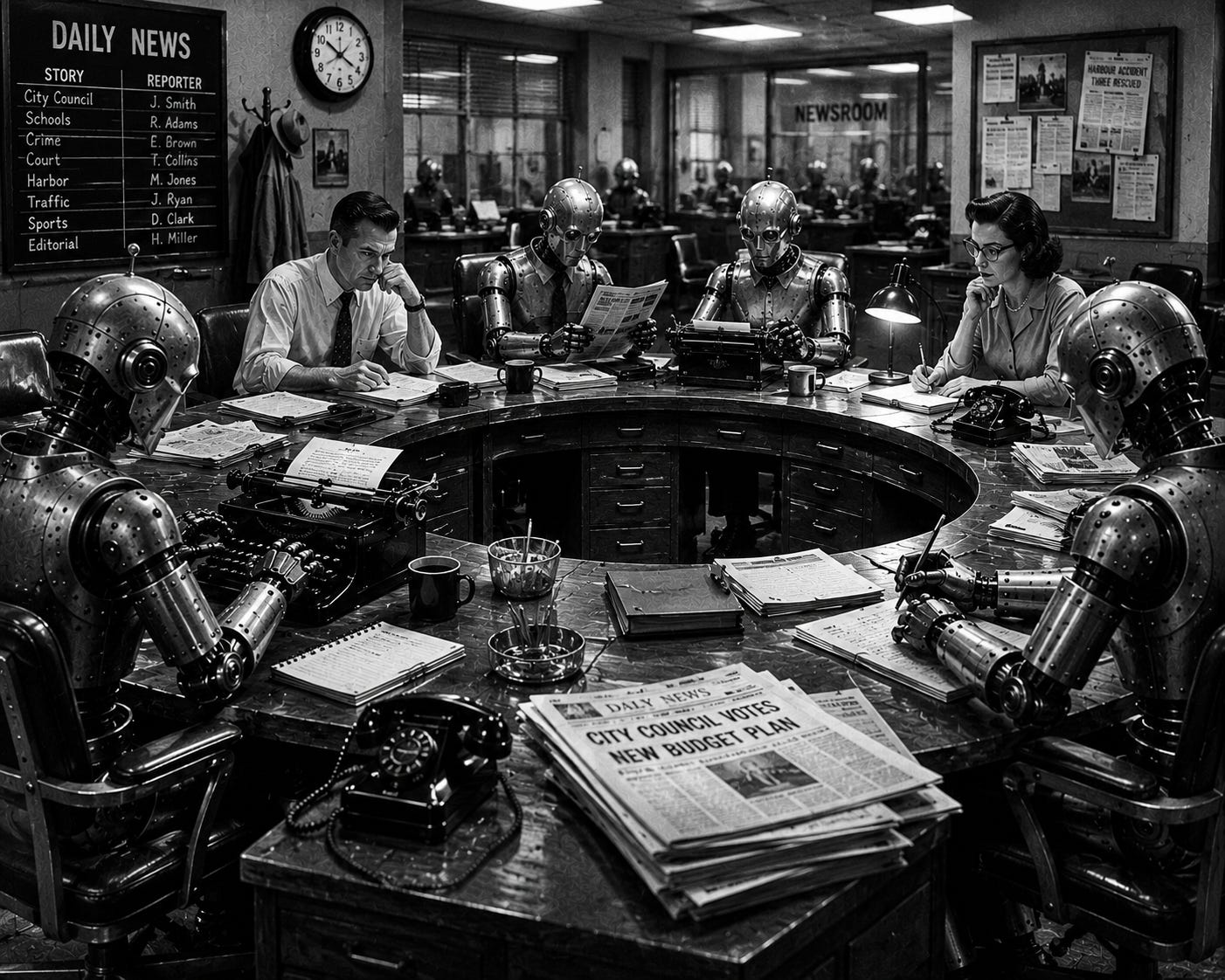
What species should populate the newsroom of the future?
Perhaps that question requires some context. I’m writing this from sunny Copenhagen, where I’m attending the Nordic AI in Media AI Summit, a packed gathering of AI-focused journalists and technologists; tickets to the event were in sch high demand that they sold out within minutes of being available.
This being a collection of news nerds, talk of AI agents — and much else — was rife, not least when Simon McNish of Reuters explained how the news agency’s tech team was moving methodically towards autonomous coding, and Florent Daudens discussed mizal.ai, his startup to create a fully agentic newsroom.
Simon’s explanation of Reuters’ step-by-step approach was fascinating, and part of it involved the creation and deployment of agents to serve as program managers, quality assurance teams and so on, in place of human teams doing similar work; and Florent spoke of an agentic editor-in-chief overseeing teams of AI reporters. All of which gives us a glimpse into the world of tomorrow.
But then again, that’s probably just the first draft of the future; there’s no real reason to populate the reimagined newsroom — and developer team — with avatars of ourselves. It’s not like we did some kind of detailed time and motion study to determine that our current hodge-podge of editors, reporters, graphics teams, copy desks, and so on was the most effective (or efficient) way of turning out stories; and even if it was, why try to turn machines into copies of humans, with all our strengths and foibles?
As I noted in a post from more than a decade ago, when electric power replaced steam and water power in factories, it took decades before anyone realized that electrons weren’t simply a replacement for steam; they could — and should — help entirely reorganize the factory floor. Imagine if we had word processors in the 1950s and just used them to write stories and print them out to be handed to the copy boy to hand to the copy desk?
AI systems are — needless to say — very good at being AI systems: better than humans at some human tasks, worse at others, and also capable of things no human can do. Why make them mimic humans, or follow a human-centric production process?
Or as Lars Adrian Giske, who was also at the NAMS conference, put it in a sharp LinkedIn post about the instinct to create machine analogs of human roles:
I get it, it makes the new thing readable to people and gets buy-in. But I also think it might make the systems worse than they need to be.
We keep handing agents a business model that was already struggling and asking them to run it faster. The more interesting question is what happens if you don't do that. Give agents the actual goal, meeting people's and society's informational needs, let them figure out what structure fits the real pressures and constraints without inheriting an org chart from print or a revenue model from 2005. What do they build?
When I initially tried to create an AI editor, I did what I assume we all do the first time: Ask Claude (or ChatGPT, or Gemini, or whatever) to take on the persona of an editor, and try to fulfill that role. Claude does a decent job at it, and when you deploy all multiple models collectively to debate each other’s work, you actually get to see a very complementary set of skills emerge.
But I was still imagining the AI system as a one-for-one substitute for a human role; I hadn’t really seen past the fact that “editor” was really a bucket of different skills that we’ve bundled into a single human, for better or worse, and often as the result of historical happenstance, limited resources, or simply because that’s what the workflow required.
So when I built my deconstruction bot, I didn’t ask Claude to be an editor; I broke down the tasks I wanted into discrete functions — extracting the explicit and implicit thesis, the facts asserted to back them up, the assumptions underpinning the thesis, the analysis behind the story, and so on — and set it off to carry out them out individually, essentially each as an AI skill. I’m guessing that’s not the way most human editors work; but this way, I got to define what I wanted done — not to create my vision of a perfect human editor, but more prosaically just to ensure specific tasks were carried out.
The results are much better — not because Claude is smarter on each of these skills, but because we can specify much more clearly what we want out of the system for each particular task.
Or, as Claude reminded me in an earlier experiment of why the “be an editor” prompt isn’t useful:
AI is doing something more like “reasoning by analogy to editorial work I’ve seen” than “executing a well-defined editorial process.”
In other words, it’s doing what it thinks an editor does; it really doesn’t know. And even if it did know, surely there are better ways that we can organize the newsroom, if only we had the skills and capabilities that AI systems have.
AI systems are much more than simply a cheaper, faster, more tireless replacement for humans — even if they may also be that; they will enable new capabilities, new workflows and new outputs.
What are those new workflows? Will they be a series of sequential — or parallel — processes optimized to machine capabilities, with humans interjected at strategic points to take advantage of whatever special skills we possess? I honestly don’t know yet what this could look like; but if we don’t ask the questions, we’ll never find the answers.
One thing seems clear to me: The newsroom of the future isn’t going to be populated by machine versions of ourselves.
They’ll be machine versions of something; but what?