
Layer Cake

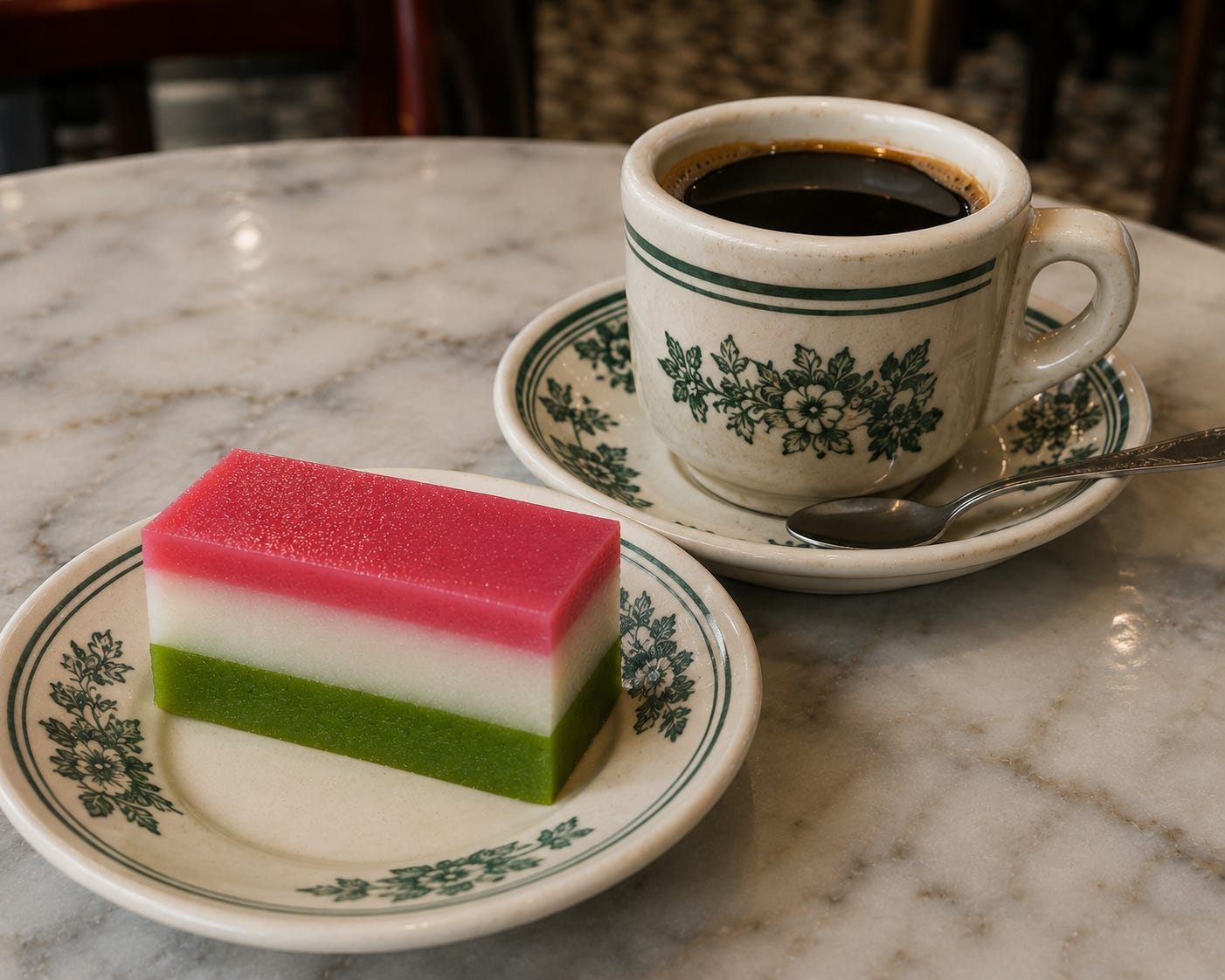
Information is a many-layered thing.
I’m in Singapore, and as always, food is high on the agenda. And so today’s analogy — metaphor? — is the iconic Singapore dessert, kueh lapis, literally layer cake. And it came to mind as I was reading an interesting paper by Hilke Schellmann and others about the increasing difficulty of verifying anything in an age of AI-enabled facts.
Which is undeniable: It used to take real effort — say, in the Stephen Glass era — to fabricate documents, websites, emails, photographs and other supporting evidence to convincingly make a made-up story look real. Now AI will help you do all of that at the push of a prompt. All this points to a real problem for those of us in the truth business; it’s becoming increasingly difficult for journalists — and anyone else interested in verification — to establish if something is true, or at least credible.
But that’s only part of the problem. There are multiple layers in the public information ecosystem, with verification as just the first. And as important an issue as that is, we also have to solve for the other two layers if we want a healthy information ecosystem.
We need to verify information; that’s a basic requirement. But then we also need to know who verified the information; that’s the provenance layer. And then we have to ensure the systems that bring that information to people are providing them the right facts, with the right context, and are serving their interests and not someone else’s. Call it the last mile layer.
We can only solve them one at a time; but we have to keep in mind solving one or two isn’t enough. We need all the layers to work — they’re all dependent on each other.
Hilke’s paper lays out the problems in the verification layer clearly:
Faking content is cheap, and getting cheaper. Verifying is time-consuming and will likely get more time-consuming soon as the reference points a reporter once checked against — a website, a document, a public record, a voice on the phone — can now themselves be fabricated, so establishing one fact increasingly means establishing the facts beneath it.
In other words, it’s not just that the work is getting harder; it’s that the economics of fact-checking are moving in the wrong direction. And the capabilities for fakery continue to outpace the capabilities for fact-checking, as evidenced by the release — and immediate withdrawal — of a Google Earth tool that let users put, well pretty much anything anywhere on what looked like an entirely accurate satellite image. (It was one of those what-were-they-thinking moments.)
The paper identifies some useful interventions that could help address the problem, but I’m not going to suggest this is an easy nut to crack; none of the layers are.
The second layer is about how to communicate that something has been verified and who did it; in other words, if you can crack the first layer, how do you tell someone you did? Say The Wall Street Journal — and only the Journal — manages to nail down that a particular oil refinery in the Gulf has been damaged. How can we make sure that it’s their version of facts — assuming we have faith in their processes — that we read?
That’s a problem of provenance, and it’s basically a metadata issue — which may sound simple, but it’s not. What are the systems that ensure their account is attributed to them? That’s the issue that people like Sannuta Raghu are working on; her news atoms idea is a smart possible solution that involves building a metadata standard that news organizations — and others — adopt, and that AI systems can and will use. Sannuta’s doing great work, but we need more people to focus on this.
Layers one and two are related — after all, information isn’t just mysteriously verified; it’s verified by someone (or something, or some system). But the two layers are separate: Verification is one task; making sure we know who did it, especially as the information travels through an increasingly AI-intermediated information ecosystem, is a completely different one.
Layer three is another tough one. Let’s assume we find a way to verify facts and ensure that AI systems know who did the verification. If an agent is getting and assembling news for us — which is the way I suspect most of us will get news in the near future — how can we be sure that it’s getting the right facts, and the right context, that creates the story that serves our interests?
That’s not a misinformation problem — or at least, it isn’t, if we solve layers one and two. It’s a context and intent problem. All stories omit information; we couldn’t possibly absorb every fact about an event we were interested in. Journalists curate information and craft narratives; that’s our job. As AI systems increasingly take on those functions, how can we be sure that what they choose to leave out or highlight are the facts that matter to us? Will they be shading stories to serve some other interest — the platforms that own them, advertisers — rather than ours?
If I tell you the mayor owns far more properties and flashy cars than his salary can afford, that seems like a pretty good signal that he may be corrupt — especially if I conveniently leave out the background that he inherited a billion dollars from a rich uncle. Context matters, and it matters that systems at least try to give us the context that matters.
That’s a problem of — let’s call it fiduciary duty. Financial advisors — some of them, at least — are required by law to have our best interests at heart; they’re not supposed to sell us financial products we don’t need so they can collect fat commissions. The same with lawyers and real-estate brokers. But when Gemini, or Claude, or ChatGPT summarizes a news event for you, what does it consider relevant or irrelevant? We don’t have — but we need — similar standards for AI agents.
We spend a lot of time worrying about the first layer, as we should. But we often overlook the next two layers, not least because these haven’t been things we’d had to worry about before. But now they are a critical part of the coming news ecosystem, and much of our work will be undone if we don’t devote at least as much attention to them as well.
Kueh Lapis is not tasty when it only has one layer.
Kendal would love to read/hear this piece! The "truth business". People sometimes forget that. While you're there, have some laksa and think of me