
Only Human

What are humans good for, anyway?
And I don’t mean to ask that question in the tone my mother might have once asked me about my utility in the world; although, of course, I lie: My mother has always been nice to me. (Sorry, Mom!) But I do mean to ask it in the nicest possible way:
What are we good for, and more importantly, when does it matter?
I’m mulling this as I read Agnes Stenbom Swedling’s interesting post at the Reuters Institute, about the difference between “machine-centric hybridisation” and “human-centric hybridisation” in newsrooms. The first she defines as creating workflows centered around what machines are good at — speed, scale, etc — and then trying to shoehorn humans into them; the second privileges human skills — we’ll come to them in a minute — and builds systems around those instead.
It’s a smart distinction, and one we should pay more attention to; it’s a close relative of what I used to call the “cybernetic newsroom,” built around the idea that we don’t want machines to be poor imitations of humans or vice versa. We want an organization that optimizes for what each species does best.
Agnes notes that we think we’re doing the second — building around humans — when in fact we’re doing the first:
What is being built – incrementally, often unintentionally – is a form of machine-centric hybridisation. Workflows are optimised for what machines do well: speed, scale, pattern recognition, cost efficiency. Humans are then positioned around those systems, adapting their tasks, roles, and decision-making to fit the logics of machines.
The consequence is a subtle but significant inversion: rather than engaging in uniquely human activities, work is reorganised to fit machine-driven processes. And once that inversion is embedded at the infrastructural level, it becomes increasingly difficult to reverse.
She points to the EPOCH framework to identify what humans are good at: Empathy and emotional intelligence; Presence, networking, and connectedness; Opinion, judgment, and ethics; Creativity and imagination; Hope, vision, and leadership. (You gotta love a good acronym.) Or more practically:
...journalism has never been just a workflow. It holds a set of judgments: what is worth noticing, what is meaningful, what is fair, what is true and relevant in context and not just in data.
And that’s all true — but the broader questions are: when do we need each of those traits, when do we need to expand on them, when do we need to subvert them, and when do we need to augment them? Or, more broadly: When are they valuable to our mission, and when do they get in the way?
Because, let’s face it, it’s not like human judgment and human traits have served us all that well all the time. If you were part of the HIV-positive community in New York City in the early 1980s, the set of judgments that mainstream journalists imposed on coverage rendered you mostly invisible; that’s to some extent an indictment of prejudice on the part of editors and reporters, but it’s also simply the end result of a business model that rewards stories that reach the largest possible target demographic, and that’s not people with AIDS. (OK, I’m being very generous here; there was a lot of prejudice and blind spots behind that omission.)
Which is to say, sometimes a machine can do better than we can at some of the things we’re supposed to be better at.
And more importantly, human traits are valuable when they help us fulfil our mission, which is — or should be — helping the public access the information they need. When they help, we should lean into them. And when they don’t…
After all, when self-driving cars came along, we didn’t ask what ineffable human qualities Uber drivers had and insist that we optimize around them. We just wanted to get from point A to point B, and a garrulous chauffeur who insists on asking how many children you have (it’s happened more than once to me) is, as the Brits say, “surplus to requirements.”
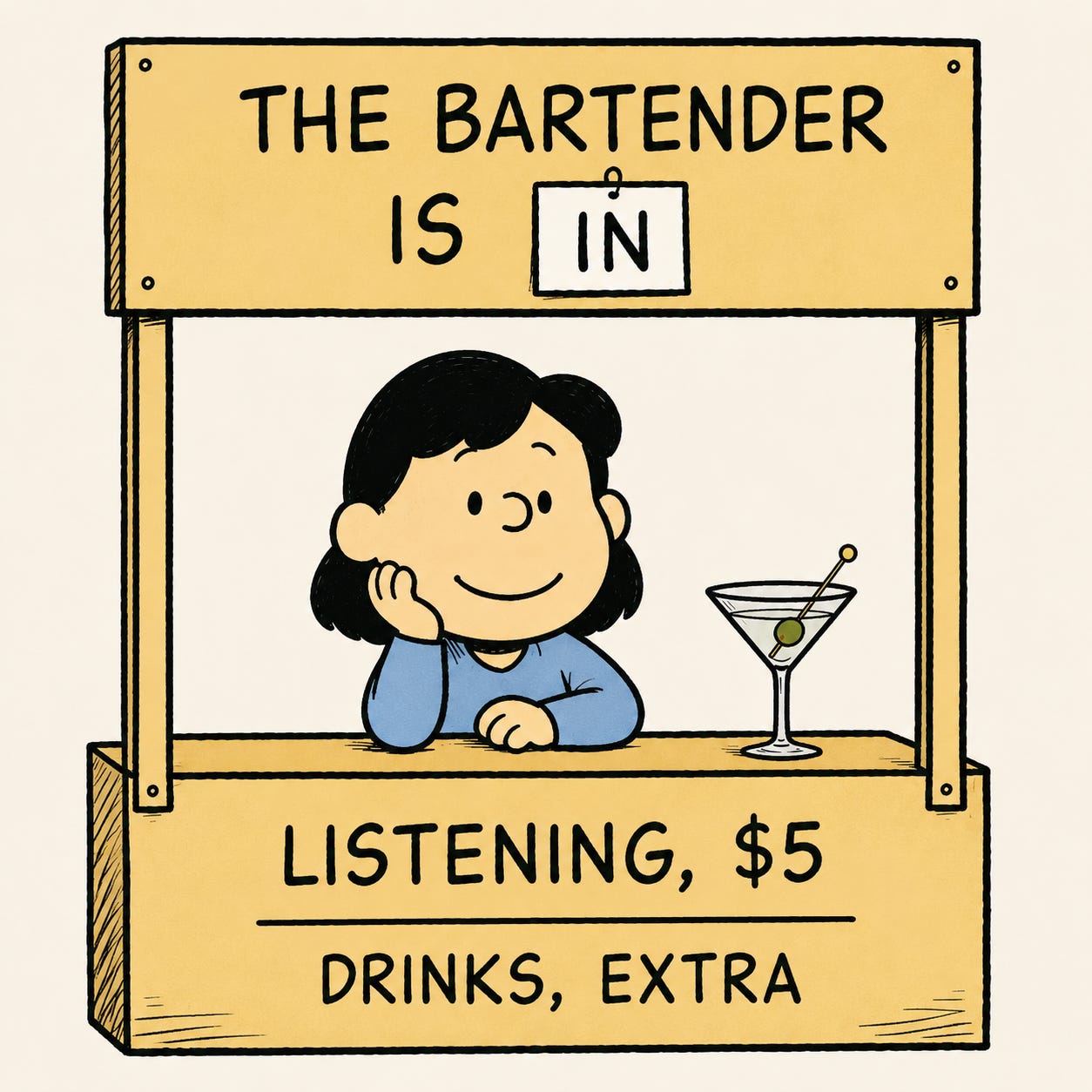
Or to put it another way, sometimes, when you go to a bar by yourself, it’s because you want a stiff drink to drown your sorrows alone. Sometimes it’s because you want someone to listen to your woes. And sometimes it’s to try and meet and hook up with someone (you do you; this is a judgement-free Substack.) A robotic cocktail dispenser optimizes for the first use case; a bartender who can feign sympathy well solves for the second.
I can’t help you on the third.
The question isn’t whether humans matter. It’s when we do.
And some bonus note:
The Tow-Knight Center website is live! Check it out!
And our colleagues (literally true; there are two of them) at the Journalism Protection Initiative, also here at the Newmark J-School, just released JESS, the journalist safety and security tool they built in partnership with the ACOS Alliance (and some help from us.) (We wrote about it on Thursday.) Check it out, too.
And finally, as a random fun read and yet another example — if you needed one — about how low the barrier to entry for new products is, as well as how the main constraint on building cool new stuff is imagination, check out the brothers who coded an agent to call thousands of bakeries in France to build an index of baguette prices. May the flour be with you, as they say.