
Talk To Me

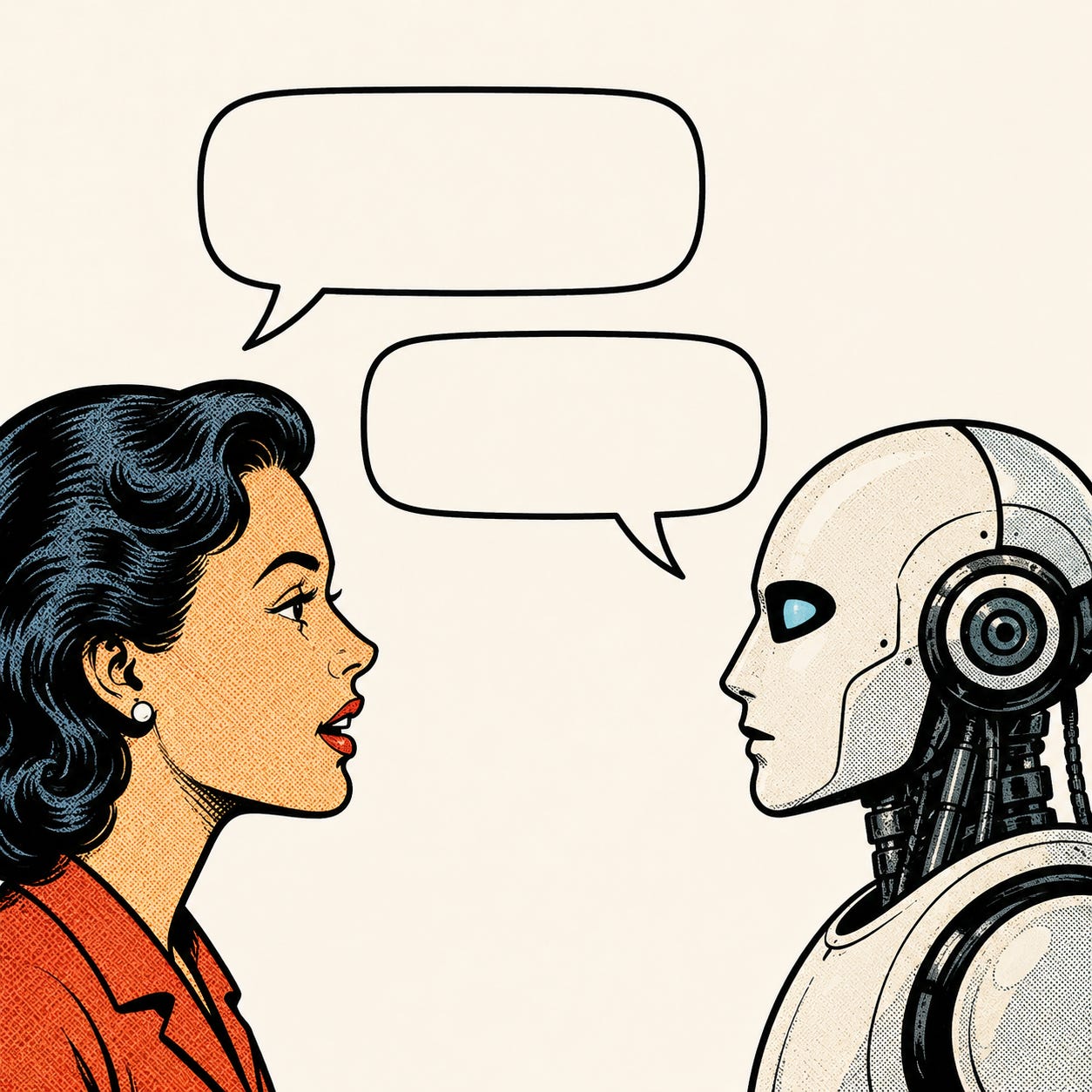
Voice, the final (for now) frontier.
ChatGPT Live — OpenAI’s new speech interface — dropped the other day, and it’s an impressive approximation of a nearly human conversation (there’s a bit too much of a gap before it replies, but if you assume you’re talking to your slightly deaf granduncle, albeit a much better informed version of him, it feels just right.) Older speech-to-text and text-to-speech systems worked, but they felt more like a series of questions and answers; this one feels different, more natural.
What will this mean for news? A lot.
This isn’t simply another medium for communicating information, although it is that: it’s a potential driver of a huge, new, untapped demand for news; it carries very different challenges — and upsides — for our mission; and it sharpens the key questions of who controls that “last mile” of users, and how the work of news gathering is actually paid for.
But first, a victory lap.
I wrote about voice interfaces in the prehistoric days of 2018, and I just want to note that I called it back then, even if the tech then turned out to be a dud. (Remember Google Duplex? I don’t, either.) As I wrote then, imagining what the world could be like:
Remember this advice from way back about writing a story? “Just imagine you’re in a bar, telling someone what happened today....” Oh, sure. Of course that’s how stories are actually written. Can you imagine actually reading out a newspaper story to someone at a bar and pretending that’s how you talk? But maybe - in a back-to-an-imagined-past-and-a-new-future kind of way - that’s precisely where news is going.
…
But as a way of giving people the information they need, allowing them to steer into sidebars and then returning to the main narrative, skipping over facts they already know - there’s much to recommend a - made-up - system like this.
And now we’re nearly here. I tried asking ChatGPT Live about the (then-breaking) news about Graham Platner’s suspended campaign for the US Senate; the system, in a lovely woman’s voice with a quasi-Australian accent (don’t ask) answered helpfully and accurately, waited patiently as I regularly interrupted it and cut off answers once I had heard enough, and steered it into questions I wanted addressed — what would happen if he didn’t drop out by the official deadline; how were the prediction markets treating the impact of this on Democrats winning the Maine seat, and so on. It misunderstood me a few times, but that was easy to interrupt and correct it; and then it would say, “got it,” and proceed to give me the right answer. (For the record, I had been devouring news about the campaign, so knew enough to fact-check ChatGPT’s answers.)
It was a satisfying and — frankly — more productive exercise than my obsessively reading every piece about Platner that I had come across.
Now interactive voice news — the proverbial bar stool conversation — is nearly here. So what?
For one thing, this could — will likely — massively expand the market for news and “current awareness,” as we called it in some Reuters products, back in the day. Right now it takes an effort to shift your attention to catching up with news; unless you’re listening to a podcast, you need to use your eyes to ingest information, and that precludes you doing a host of other things, not least driving or walking — assuming you want to do those activities safely. Now you can just talk, and your ears — which, as Bloomberg’s Joe Weisenthal notes in a fascinating interview in The Atlantic with Derek Thompson, are always on — do the ingesting. It’s efficient, but more than that — because it’s interactive, there’s no barrier to saying, if you were distracted for a second, “wait, can you repeat that?” Try that with a podcast.
And even more than that — because, again, it’s interactive — you can focus on the parts that are relevant to you, cutting off the system whenever it strays into the boring bits. If you’ve ever sat through the kind of 2,000-word answer that ChatGPT seems fond of spitting out, you’ll know how satisfying this can be. Although, of course, because it’s powered by an LLM, it could — in theory at least — be giving you a highly personalized answer to begin with anyway.
What’s not to like?
Well, a few things. It can be hard to provide provenance in oral communication, except with a ton of “according to,” and then conversation doesn’t feel human. As the ever-insightful Florent Daudens notes, this may work best in conjunction with a screen — with your eyes:
For years, the voice debate has often been framed as a replacement question: will talking replace typing? Will voice replace the screen? Let’s frame it differently.
Voice may replace the first gesture.
Instead of opening an article, scanning a feed or carefully composing a search query, you begin by asking what you want to know. The conversation helps you orient yourself.
And then there’s a danger, obviously, that a voice system can be so glib, so trustworthy sounding, that we gloss over what may be serious caveats in the information we’re being given. Humans have evolved, for better or worse, to trust some types of voices, some intonations, some patterns of speech. Machines can mimic them to our detriment — although also presumably, for good as well.
But it isn’t just that voice systems can copy how we talk; we’re likely to also have to adapt to this new form of information delivery as well — even if it seems like how we’ve always naturally communicated.
Voice systems will also force us to rethink some of the architecture of information. That Atlantic interview — you should read the whole thing, and with thanks to Florent for noting it in his post — references work by Walter Ong, a priest, linguist, philosopher and more, about how the shift from oral to written cultures changed how we process information and communicate. Written work allows people to come back to information, to look at citations, to track complex arguments. As Joe Weisenthal notes about Ong’s book, Orality and Literacy:
The gist is that humans [in oral cultures] fundamentally think differently when they’re in this world that you can’t write anything down, that you can’t look anything up. For most of human history, there was no way to look up anything at all. There was no reference material and so forth. And as such, people had to optimize their communication for the conditions of that time.
How much would a shift back to a world that’s more oral affect how we think about information — about how we think?
Although a much more oral society powered by AI would have some modern quirks: Oral communication has historically been a social activity; there’s no real point to talking to yourself (I mean, I do it, but I’m me.) Talking involved a back-and-forth with someone else, with all the potential external factors in play, both positive (“here’s my chance to impress my boss”) and negative (“what if she thinks I’m an idiot?”)
But talking to an LLM isn’t exactly the same as talking to another human, even if it can feel that way; you can — in theory — ask questions you would never want another person to know you were asking. Perhaps you’re worried you’d sound uninformed or judged for a politically incorrect query; an LLM doesn’t care. (Well, my version of Claude is snarky with me, but that’s me.) Shuwei Fang called this the “intimacy dividend.”
That suggests we might evolve some slightly — or significantly — different way of oral communication; who knows what? The point is, just because it sounds like a conversation, we shouldn’t assume it will follow the same form as a human conversation.
All of which is to say, effective — human-like — voice communication with AI systems will likely unlock all sorts of changes, beyond just a different medium. We’ve already started to see some new behaviors with the early experiments in this area, such as with Süddeutsche Zeitung’s AI voice assistant that lets readers query its investigation into the Wirecard scandal in Germany.
But some things don’t change, and especially two critical issues: What a business model underpinning all this expanded demand might be, and who will control these voice interfaces, this new “last mile” to users?
Voice might expand the market, but it doesn’t magically solve the business model problem, and arguably makes it worse, given the difficulty of effectively attributing provenance in a spoken communication. And far more importantly, the voice system — and the LLM that underpins it — controls the relationship with the end-user; it captures what the users care about, and it pulls together the information to fulfill that need. There’s much to recommend a world where users can get much more personalized, much more contextualized information.
But only if the system is working in their interest.
What if it’s really working for someone else?
That’s a lot to talk about.